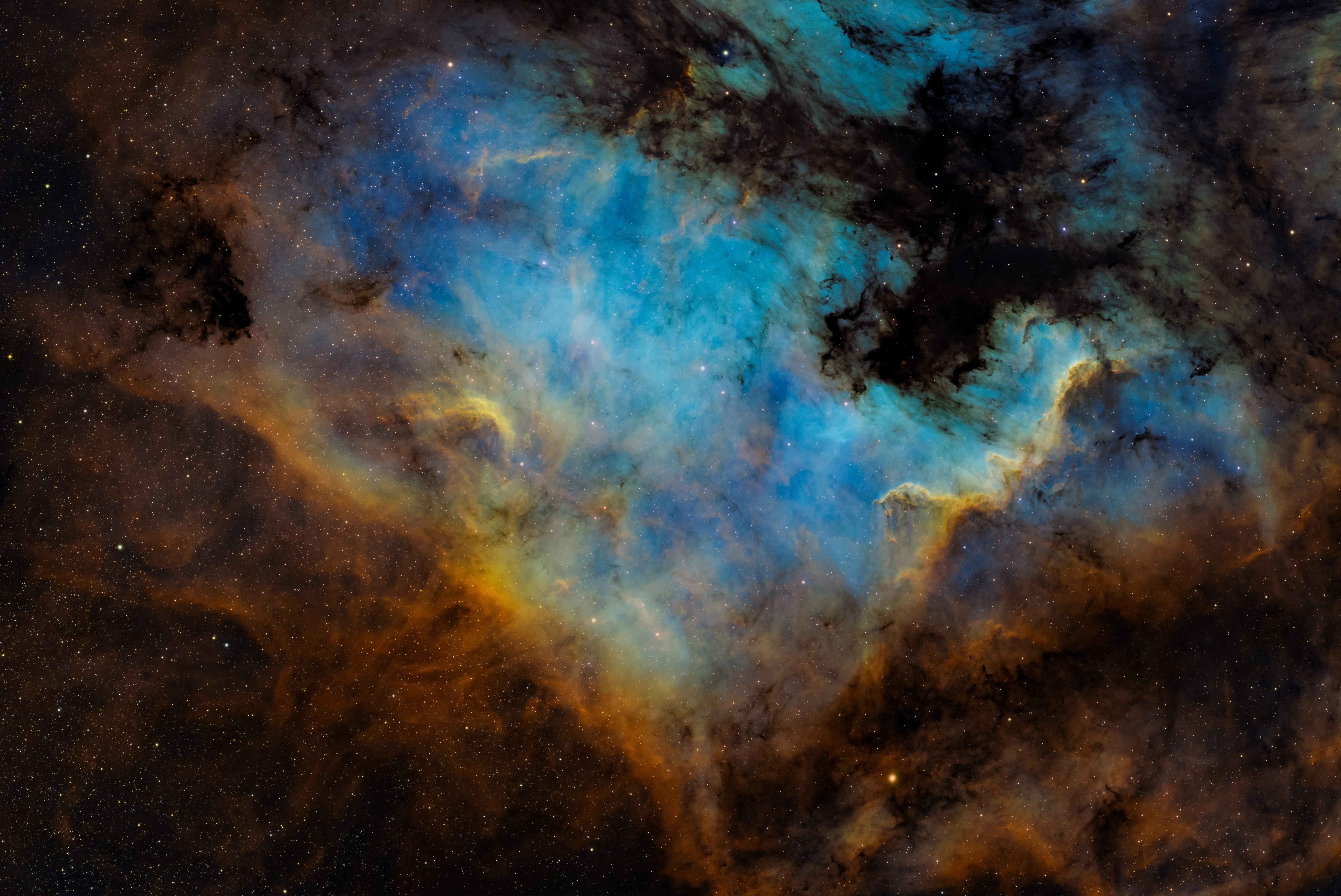
North America Nebula
A wide field across the luminous coast and the dark Gulf of Mexico.
- Object
- NGC 7000
- Captured
- Published
About
The North America Nebula (NGC 7000) is a vast emission nebula located approximately 2,600 light-years away in the constellation Cygnus. Its distinctive shape, resembling the continent of North America, is formed by enormous clouds of hydrogen gas illuminated by ultraviolet radiation from nearby hot, massive stars. The surrounding dust obscures portions of the glowing gas, creating the dark boundaries that define its recognizable coastline, particularly the prominent “Gulf of Mexico” region. Spanning roughly 100 light-years across, the nebula is part of a much larger complex of gas and dust that includes the neighboring Pelican Nebula, with active star formation taking place throughout the region.
Commentary
This image was captured and processed back in September 2022 using my William Optics RedCat 71. When I first received the telescope, it had collimation issues that required sending it back to William Optics in China for service. Fortunately, it returned in excellent shape and subsequently became my main workhorse for widefield imaging.
This image is a testament to just how wonderful a telescope the RedCat 71 turned out to be. It has served me incredibly well over the years, and if I ever decide to part with it, I’ll certainly be sad to see it go.
It’s not a perfect image. Looking back, I appear to have done something a little strange during star processing that left some of the stars looking slightly faded. I’ve decided to leave it as it is, though. This was one of the first astrophotographs I was genuinely proud of, and I’d rather preserve it as a reflection of where I was in my imaging journey at the time than revisit it with everything I’ve learned since.
Target & sky
- Object / designation
- NGC 7000
- Constellation
- Cygnus
- Right ascension
- 20h 59m 37s
- Declination
- +44° 33′ 56″
- Field of view
- 3.87° × 2.58°
- Image scale
- 2.23″/px
- Palette
- Hubble palette (SHO)
- Imaging site
- Backyard
- Bortle class
- 5
Integration
| Channel | Frames | Exposure | Duration | Capture nights | Camera settings |
|---|---|---|---|---|---|
| SII | 45 | 300s | 3h 45m |
| |
| Hα | 45 | 300s | 3h 45m |
| |
| OIII | 45 | 300s | 3h 45m |
| |
| Total integration | 11h 15m | ||||
- Channel
- SII
- Frames
- 45
- Exposure
- 300s
- Duration
- 3h 45m
- Capture nights
- Gain (camera setting)
- 100
- Offset (camera setting)
- 50
- Sensor temperature
- -10 °C
- Channel
- Hα
- Frames
- 45
- Exposure
- 300s
- Duration
- 3h 45m
- Capture nights
- Gain (camera setting)
- 100
- Offset (camera setting)
- 50
- Sensor temperature
- -10 °C
- Channel
- OIII
- Frames
- 45
- Exposure
- 300s
- Duration
- 3h 45m
- Capture nights
- Gain (camera setting)
- 100
- Offset (camera setting)
- 50
- Sensor temperature
- -10 °C
Total integration11h 15m
Equipment
- Telescope / OTA
- William Optics Redcat 71
- Camera
- ZWO ASI2600MM-Pro
- Mount
- 10Micron GM1000 HPS
- Filters
- Chroma 50mm Unmounted H-alpha 3nm Bandpass
- Chroma 50mm Unmounted OIII 3nm Bandpass
- Chroma 50mm Unmounted SII 3nm Bandpass
- Effective focal length
- 350 mm
- Effective focal ratio
- f/5
Software
- Software
- Pleiades Astrophoto PixInsight
- Software
- Adobe Lightroom
- emission nebula
- Cygnus