Veil, Partial
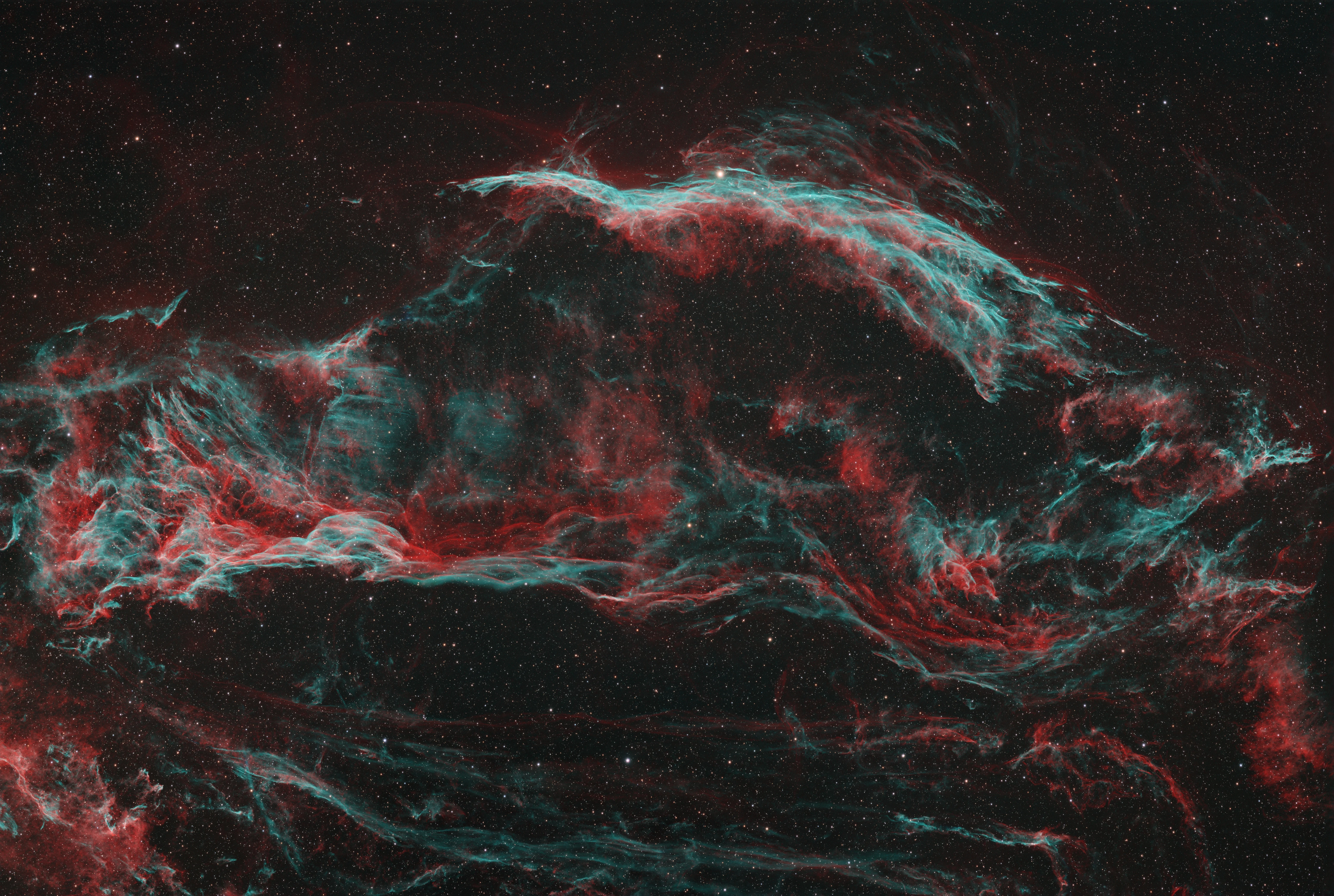
Filamentary shock fronts from a supernova remnant in Cygnus. Better known as the Witch's Broom.
- Object
- NGC 6960
- Captured
- Published
About
The Veil Nebula, also known as the Cygnus Loop, is an enormous supernova remnant located approximately 2,400 light-years away in the constellation Cygnus. Unlike many of the nebulae we photograph, which are stellar nurseries where new stars are being born, the Veil is the aftermath of a star’s violent death. Roughly 10,000 years ago, a massive star estimated to have been about 20 times the mass of our Sun exhausted its fuel and exploded in a supernova, sending an enormous shock wave racing outward into the surrounding interstellar medium. Today, the expanding debris spans well over 100 light-years, forming an intricate network of delicate, glowing filaments as the shock wave encounters surrounding clouds of gas and dust.
Commentary
For me, the Veil is one of those targets that perfectly demonstrates why I enjoy astrophotography so much. There’s an incredible amount of fine structure hidden in what initially appears to be a faint, diffuse cloud, and bringing out those intricate details is especially rewarding. It’s a beautiful reminder that some of the most spectacular sights in our night sky are the remnants of events that occurred thousands of years before we ever had the means to observe them.
This imaging session, in particular, has really bolstered my desire to move up from an APS-C sensor to a full-frame sensor like the IMX455. The increased sensor area would really expand my framing options while keeping the detail just as high as we see here.
Target & sky
- Object / designation
- NGC 6960
- Constellation
- Cygnus
- Right ascension
- 20h 47m 58s
- Declination
- +30° 49′ 47″
- Field of view
- 2.42° × 1.63°
- Image scale
- 1.41″/px
- Palette
- HOO, Dual Narrowband
- Imaging site
- Backyard
- Bortle class
- 5
Integration
| Channel | Frames | Exposure | Duration | Capture nights | Camera settings |
|---|---|---|---|---|---|
| R | 20 | 30s | 10m |
| |
| G | 20 | 30s | 10m |
| |
| B | 20 | 30s | 10m |
| |
| Hα | 25 | 300s | 2h 5m |
| |
| OIII | 30 | 300s | 2h 30m |
| |
| Total integration | 5h 5m | ||||
- Channel
- R
- Frames
- 20
- Exposure
- 30s
- Duration
- 10m
- Capture nights
- Gain (camera setting)
- 100
- Offset (camera setting)
- 50
- Sensor temperature
- -10 °C
- Channel
- G
- Frames
- 20
- Exposure
- 30s
- Duration
- 10m
- Capture nights
- Gain (camera setting)
- 100
- Offset (camera setting)
- 50
- Sensor temperature
- -10 °C
- Channel
- B
- Frames
- 20
- Exposure
- 30s
- Duration
- 10m
- Capture nights
- Gain (camera setting)
- 100
- Offset (camera setting)
- 50
- Sensor temperature
- -10 °C
- Channel
- Hα
- Frames
- 25
- Exposure
- 300s
- Duration
- 2h 5m
- Capture nights
- Gain (camera setting)
- 100
- Offset (camera setting)
- 50
- Sensor temperature
- -10 °C
- Channel
- OIII
- Frames
- 30
- Exposure
- 300s
- Duration
- 2h 30m
- Capture nights
- Gain (camera setting)
- 100
- Offset (camera setting)
- 50
- Sensor temperature
- -10 °C
Total integration5h 5m
Equipment
- Telescope / OTA
- Astro-Physics 110mm f6 StarFire GTX
- Camera
- ZWO ASI2600MM-Pro
- Mount
- 10Micron GM1000 HPS
- Filters
- Chroma 50mm Unmounted H-alpha 3nm Bandpass
- Chroma 50mm Unmounted OIII 3nm Bandpass
- Antlia V-Pro 50mm Unmounted Red
- Antlia V-Pro 50mm Unmounted Green
- Antlia V-Pro 50mm Unmounted Blue
- Reducer
- Astro-Physics 0.83x Telecompressor Corrector (110TCC)
- Effective focal length
- 550 mm
- Effective focal ratio
- f/5
Software
- Processing/Stacking
- Pleiades Astrophoto PixInsight
- Processing
- Adobe Lightroom
- supernova remnant
- Cygnus