M101: The Pinwheel Galaxy
First light with the Astro-Physics 110GTX
- Object
- M101
- Captured
- Published
About
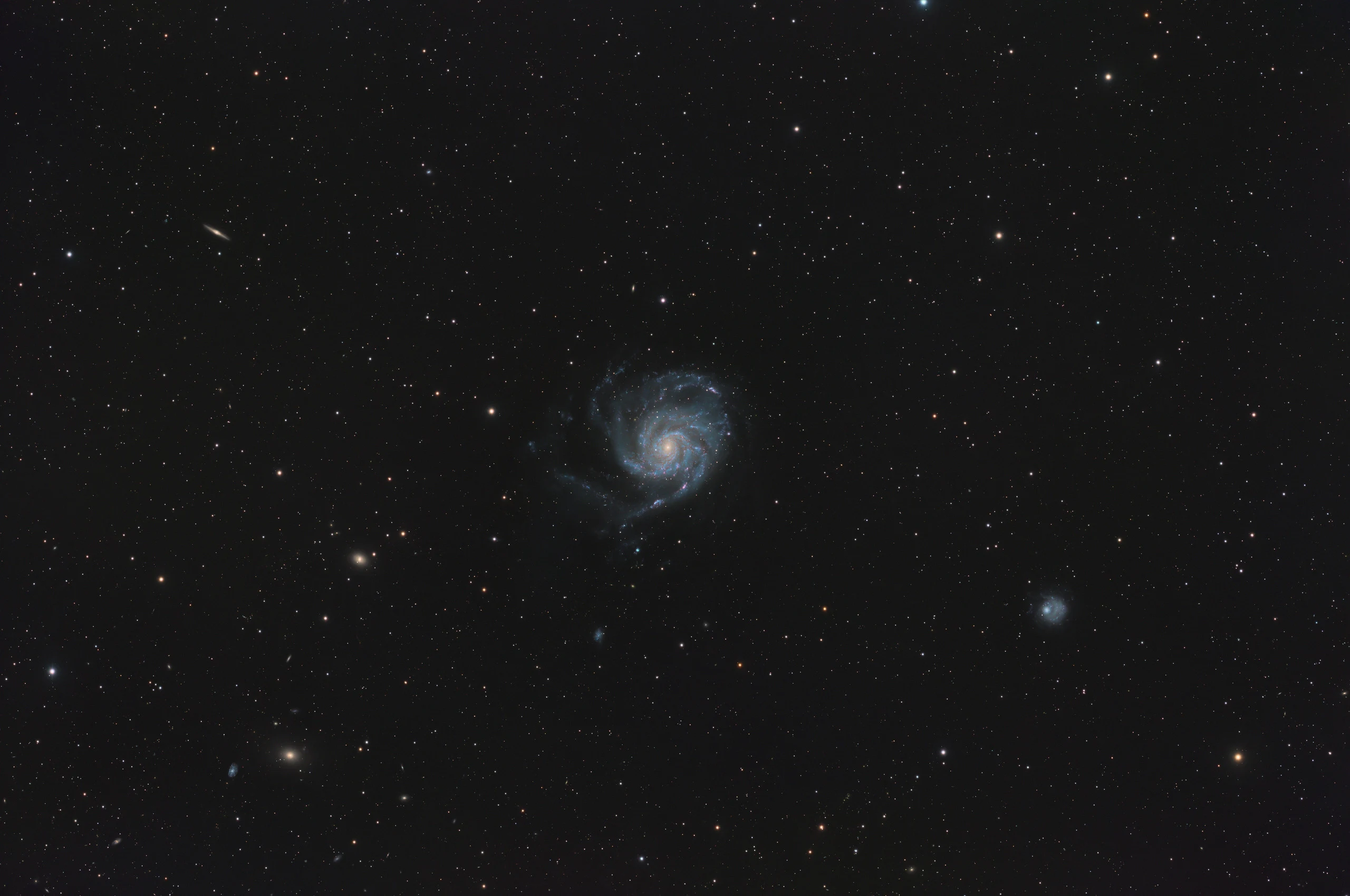
Messier 101 (M101), commonly known as the Pinwheel Galaxy, is a large, face-on spiral galaxy located approximately 21 million light-years away in the constellation Ursa Major. Stretching roughly 170,000 light-years across, it’s considerably larger than our own Milky Way. Its sweeping spiral arms are rich in gas, dust, and bright star-forming regions, where massive young stars illuminate surrounding clouds of hydrogen. M101’s somewhat asymmetrical structure is thought to be the result of gravitational interactions with neighboring galaxies, which have helped shape its prominent spiral arms and stimulate star formation.
Commentary
M101 was my first-light target with the Astro-Physics 110GTX. These LRGB exposures were captured on May 31 and June 3 from my Bortle 5 backyard in southern New Hampshire, with the Moon nearly full.
This was an opportunity to get familiar with the new scope and see what it could do. The setup paired the 110GTX and f/5 telecompressor with a ZWO ASI2600MM Pro on the 10Micron GM1000 HPS, using Antlia V-Pro LRGB filters. Processing was done in PixInsight.
Target & sky
- Object / designation
- M101
- Constellation
- Ursa Major
- Right ascension
- 14h 03m 08s
- Declination
- +54° 19′ 38″
- Field of view
- 2.40° × 1.59°
- Image scale
- 1.41″/px
- Palette
- Broadband
- Imaging site
- Backyard
- Bortle class
- 5
Integration
| Channel | Frames | Exposure | Duration | Capture nights | Camera settings |
|---|---|---|---|---|---|
| L | 140 | 60s | 2h 20m |
| |
| R | 70 | 120s | 2h 20m |
| |
| G | 69 | 120s | 2h 18m |
| |
| B | 70 | 120s | 2h 20m |
| |
| Total integration | 9h 18m | ||||
- Channel
- L
- Frames
- 140
- Exposure
- 60s
- Duration
- 2h 20m
- Capture nights
- Gain (camera setting)
- 100
- Offset (camera setting)
- 50
- Sensor temperature
- -10 °C
- Channel
- R
- Frames
- 70
- Exposure
- 120s
- Duration
- 2h 20m
- Capture nights
- Gain (camera setting)
- 100
- Offset (camera setting)
- 50
- Sensor temperature
- -10 °C
- Channel
- G
- Frames
- 69
- Exposure
- 120s
- Duration
- 2h 18m
- Capture nights
- Gain (camera setting)
- 100
- Offset (camera setting)
- 50
- Sensor temperature
- -10 °C
- Channel
- B
- Frames
- 70
- Exposure
- 120s
- Duration
- 2h 20m
- Capture nights
- Gain (camera setting)
- 100
- Offset (camera setting)
- 50
- Sensor temperature
- -10 °C
Total integration9h 18m
Equipment
- Telescope / OTA
- Astro-Physics 110mm f6 StarFire GTX
- Camera
- ZWO ASI2600MM-Pro
- Mount
- 10Micron GM1000 HPS
- Filters
- Antlia V-Pro 50mm Unmounted Blue
- Antlia V-Pro 50mm Unmounted Red
- Antlia V-Pro 50mm Unmounted Green
- Antlia V-Pro 50mm Unmounted Luminance
- Reducer
- Astro-Physics 0.83x Telecompressor Corrector (110TCC)
- Effective focal length
- 550 mm
- Effective focal ratio
- f/5
- Power distribution
- Pegasus Astro Powerbox Advance
- Tilt adjustment
- Wanderer Astro Wanderer ETA M54 Automatic Tilt Adjuster
- Filter wheel
- ZWO EFW 7 × 2 inch
Software
- Processing/Stacking
- Pleiades Astrophoto PixInsight
- Processing
- Adobe Lightroom
- spiral-galaxy
- rgb
- full-color